Marketing That Runs
on Ownership, Not Hope.
Most marketing teams are perpetually busy and perpetually unclear. Work lands without a defined owner, priorities shift with whoever spoke last, and the founder ends up pulled into every decision that should never have required them. The Workstream Engine replaces that pattern with defined streams, accountable ownership, and clear intake rules, so the system runs without constant intervention, and strategy stays protected from the pressure of the next urgent request.
Trusted by thriving businesses & educational institutions in 7+ countries








Sound Familiar?
The 6 common problems small businesses face with their marketing operations.
Businesses operating between £1–5m encounter the same operational breakdowns with remarkable consistency, not because they lack the right people, but because no structured system governs how marketing work is owned, prioritised, and executed.
1
"Nobody really knows who owns what. Everything ends up back with me."
Without defined ownership, every decision defaults to whoever is most available, usually the founder. Marketing runs on whoever picks up the phone, not on a system that works regardless of who is in the room.
2
"New requests come in constantly and everything feels equally urgent."
Without intake rules, every new idea lands as an immediate priority. The team context-switches constantly, strategic work gets displaced by whatever arrived last, and nothing accumulates the momentum it needs to produce results.
3
"I have no visibility into what the marketing team is working on day to day."
Without a visible operating structure, founders either get pulled into every detail or disengage entirely. Neither produces the clarity needed to make good decisions about where marketing should go next.
4
"Our team is stretched. Everyone is doing everything and some things fall through the cracks."
Unclear ownership boundaries mean some people are drowning while others are underutilised. Nobody explicitly agreed to carry that much, it accumulated informally, one unassigned task at a time.
5
"We keep doing the same things differently every time. Nothing is consistent."
When there is no documented process, the same task gets done differently each time depending on who does it. Quality varies. Knowledge walks out the door with each person who leaves.
6
"Every time someone leaves or we change a vendor, we lose weeks rebuilding from scratch."
Marketing systems built on people rather than processes reset every time someone leaves. The knowledge disappears, onboarding starts from scratch, and weeks are lost rebuilding what already existed.
MarketingOS
The Proven 7-Step Process to Building a Sustainable Marketing System.

What You Get
A repeatable operating layer
between strategy and execution.
The Workstream Engine is the second phase of the Marketing Operating System, installed after Strategy First Plan has established the strategic foundation. Its purpose is precise: to take every recurring marketing activity in your business, group it into a set of defined workstreams, assign an accountable owner to each one, establish an execution rhythm, and build the intake infrastructure that protects the system from scope creep and urgency-driven derailment.
It answers four questions that most marketing teams never have a consistent answer to: What work actually exists? Who owns it? How does it get done consistently? And how do you know if it is working? Until these questions have explicit answers, documented and agreed, marketing runs on informal understanding, and informal understanding degrades under pressure.
The installation process runs across 60–90 days through a structured build sequence of eight steps. By the end, every recurring marketing function has a defined owner, an execution cadence, and a clear path for how new work enters, and is evaluated against, the system.
Our Impact in the World
Marketing Systems built for entrepreneurs across 7+ countries.
Since 2023, Growth Genies has partnered with founders and leadership teams across seven countries, installing marketing systems that compound over time, not campaigns that run for a quarter and disappear. Every number below represents a business that replaced reactive, habit-driven marketing with a structured system, and started seeing results they could predict, explain, and build on.
How It Works
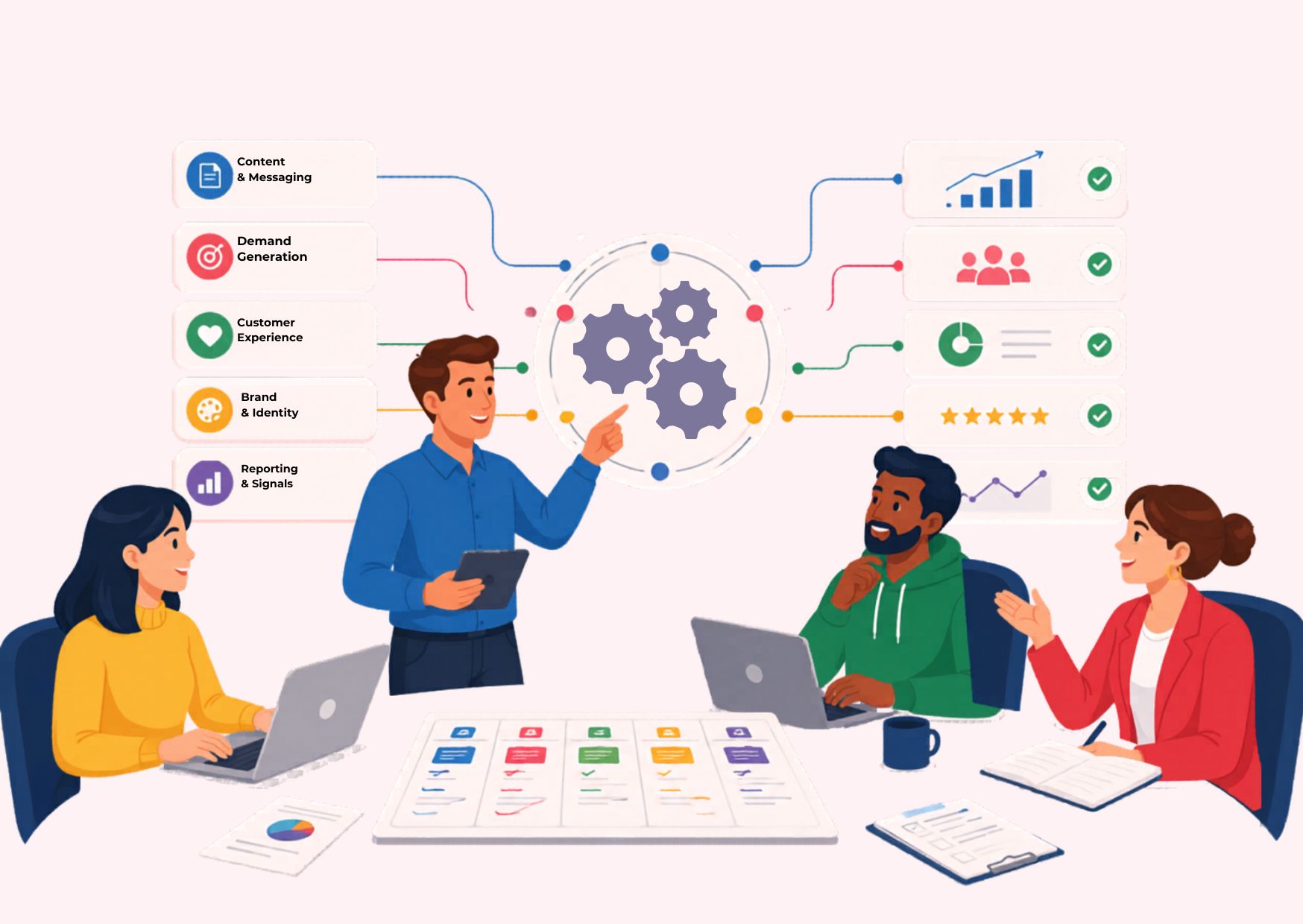
Every marketing function runs
on 1 of 5 workstreams.
All recurring marketing work, regardless of who produces it, is grouped into a maximum of seven workstreams. Each has a defined purpose, a single accountable owner, an execution cadence, and its own intake rules. Nothing operates outside the structure.
Core Content & Messaging
All recurring content production, articles, social posts, newsletters, thought leadership, governed by the Brand Engine's voice and positioning guardrails.
Demand Generation
All activities designed to attract and convert ideal clients, campaign execution, paid channels, lead magnets, and conversion path management.
Customer Experience
Post-sale touchpoints, onboarding communications, value reinforcement, review generation, and referral activation, managed through the CX Engine framework.
Brand & Visual Identity
Creative asset production, template maintenance, and visual standards governance, ensuring every touchpoint reflects the brand guardrails defined in Strategy First™.
Reporting & Signals
Monthly scorecard production, performance signal review, and leading indicator tracking, providing the decision data the Momentum Meeting requires.

What Changes In Your Business
What entrepreneurs experience in the first 90 days.

The team knows what to work on and what to defer, without asking
The Work Intake and Triage Rules give every team member a shared framework for evaluating new requests. An idea that does not fit an approved workstream does not get actioned immediately, it enters the intake process and is evaluated at the next Momentum Meeting. Execution happens in sequence, not in parallel, and the definition of "in scope" is explicit rather than negotiated each time a request arrives.
Marketing decisions stop flowing to the founder by default
When ownership is documented and decision authority is explicit, the team stops escalating work that should be resolved at the execution level. The founder regains the strategic bandwidth that was being consumed by day-to-day marketing decisions that had no other home. The Workstream Engine defines escalation paths precisely, so founders are consulted on strategy and not distracted by operations.
The process
Three sessions.
One 90-day plan.
We facilitate three structured working sessions across 3–4 weeks. Between sessions, we synthesise inputs, prepare drafts, and resolve outstanding questions, so that each session begins with materials ready for your review rather than for joint construction from scratch.
Engine Alignment & Campaign Priorities
We review strategic priorities, complete the Engine Builder Canvas across Brand, Growth, and CX, identify engine gaps or misalignment, and select one to two priority offers for the quarter. This session also defines what is explicitly out of scope, preventing scope creep before execution begins and establishing shared expectations on campaign volume.
Campaign Design Working Session
For each selected campaign, we complete a Campaign Builder Canvas, defining goal, offer, audience, core message, channel selection, CX considerations, required content assets, CTA, and success signals. Strategy becomes campaign-ready here. Execution details are noted but not actioned, that belongs to the Workstream Engine in the phase that follows.
Campaign Calendar & Readiness Review
All campaigns are mapped into the 90-Day Planner with launch windows, promotion pacing, and identified dependencies. Each campaign then passes through the Readiness Checklist, five required sections covering engine alignment, campaign clarity, scope, capacity, and measurement readiness. Campaigns that do not clear all five gates do not proceed to execution. No exceptions.

Words of Appreciation
From the businesses we've helped.
Raman has sharpened our focus on the high-impact tasks that drive growth and eliminated operational clutter, dramatically boosting our efficiency. His strategic insights offer an independent perspective that keeps us firmly aligned with our long-term business goals. Thanks to Raman’s systems expertise, we’re operating more smoothly than ever and accelerating toward our objectives.

"Working with Raman has been a game-changer for our tax department. His strategic marketing insights helped us clearly define and reach our target audience—both internally and externally. He brought a fresh perspective to how we position and communicate complex tax content, ensuring it's both accessible and engaging. Raman played a pivotal role in designing and refining our newsletters. From content structure to visual aesthetics, his input made our communication more impactful and aligned with our brand identity. Thanks to his efforts, our newsletters now see significantly higher engagement and have become a reliable touchpoint for sharing tax updates and insights. He also supported us in mapping a content strategy that balances technical depth with readability, ensuring we maintain credibility while expanding our reach. Raman’s ability to translate technical tax jargon into meaningful messages for our stakeholders is truly commendable. We are grateful for his support and would highly recommend him to any team looking to elevate their communication and outreach strategy."

As a solopreneur, it's helpful to have people in my network who can support me and my clients when things get busy. Raman Dhalwani has been a life saver for me by putting together Marketing and Brand Audits for clients. He's very thorough and always manages to surprise and delight me with the extra effort and ideas he brings to the table. Having him as a partner has been invaluable to me.

It’s been amazing working with you! The new logo aligns perfectly with our brand, and the Intelligent Auditing website is exceptionally well-organized. The colour scheme is spot on, and the overall user experience is smooth.

A very professional, friendly & timely delivered service! Would definitely recommend getting the Growth Genies impactful support!
Need to know more?
Common Questions Entrepreneurs Ask Us
Does the Workstream Engine need to be installed before we start running campaigns?
The Workstream Engine is the second phase of the Marketing Operating System, installed after Strategy First™ and alongside or following the Campaign Builder System. Campaigns can begin running during the Workstream Engine installation, in fact, having active campaigns helps the fCMO make more accurate ownership and SOP decisions. What the Workstream Engine provides is the operating structure that ensures campaigns are executed consistently and owned clearly, rather than depending on informal arrangements that degrade under pressure.
How many workstreams will we end up with?
The governing principle is between four and seven, enough to cover all recurring marketing functions without creating a structure so granular that ownership becomes fragmented. For most businesses at the £1–5m stage, five workstreams is the natural number: content and messaging, demand generation, customer experience, brand and creative, and reporting. The exact structure is determined by the Workstream Audit and designed around the team and vendor relationships already in place, not imposed from a template.
What happens when a workstream owner leaves the business?
This is precisely the problem the Workstream Engine is designed to prevent from being catastrophic. Because ownership is documented rather than carried informally, and because core SOPs describe how the work is done rather than depending on the individual doing it, a personnel change triggers a structured handoff rather than a period of undirected scrambling. The fCMO reviews the Roles Map, identifies the gap, and manages the transition, reassigning ownership temporarily where needed and updating documentation before the new owner begins.
How does the Work Intake system handle genuinely urgent requests?
The Work Intake and Triage Rules include a specific protocol for urgent requests: the fCMO assesses true urgency, makes the trade-offs explicit, naming what existing work will be paused or deprioritised if the urgent request is actioned, and ensures that temporary work does not become permanent by default. The system is designed to absorb urgent ideas without losing strategic focus. Urgency does not override the system; it is processed through it, with the trade-offs visible rather than hidden.
Do we need to document SOPs for everything?
No, and deliberately so. One of the most common failure modes in operational system building is over-documenting processes that do not need documentation, creating a compliance burden that the team stops following within weeks. The SOP Inventory step in the installation process explicitly identifies which activities need an SOP (high-frequency, high-risk, or quality-sensitive work), which would benefit from one but are not critical, and which should be intentionally left undocumented. The standard applied throughout is minimum viable process: clear enough to produce consistent output, simple enough to be followed without reference to the fCMO.
How does the Workstream Engine connect to the rest of the Marketing Operating System?
The Workstream Engine is the operational layer that makes every other MOS component function reliably. The Campaign Builder designs what campaigns will run; the Workstream Engine defines who owns their execution and how. The Scorecard and Signals tracks performance; the Workstream Engine determines who is responsible for producing and reviewing it. The Momentum Meeting makes decisions; the Workstream Engine provides the ownership structure that turns those decisions into accountable action. Without the Workstream Engine, the other components of the MOS produce strategy and plans that have no reliable path to execution.
Start Your Transformation
Stop Planning Operations. Start Running a System.
The Workstream Engine is installed as part of the Growth Genies Fractional CMO engagement. Book a free 30-minute Productive Chat and we will walk through what an installed operating system looks like for your business, the workstreams, the ownership structure, and the execution rhythm that makes it run without constant intervention.
DUBAI
Dubai Investments Park 1,
Dubai, UAE. PO Box 282895
LONDON
86-90, Paul Street,
London, UK. EC2A 4NE
Work With Us
Resources
Make better decisions every week
If you're a solopreneur, startup or SME founder who's looking for some practical advice to help you make better marketing and business decisions every week, then you're in the right place.


