Everything Starts With Strategy. Nothing Before It.
Most businesses begin marketing before they have a clear position, a defined ideal client, or a shared understanding of what success looks like. The result is activity that produces noise rather than progress. The Strategy First phase installs the strategic foundation before any execution begins, three focused meetings across 30–45 days that produce the operating brain every other step of the Marketing Operating System runs on.
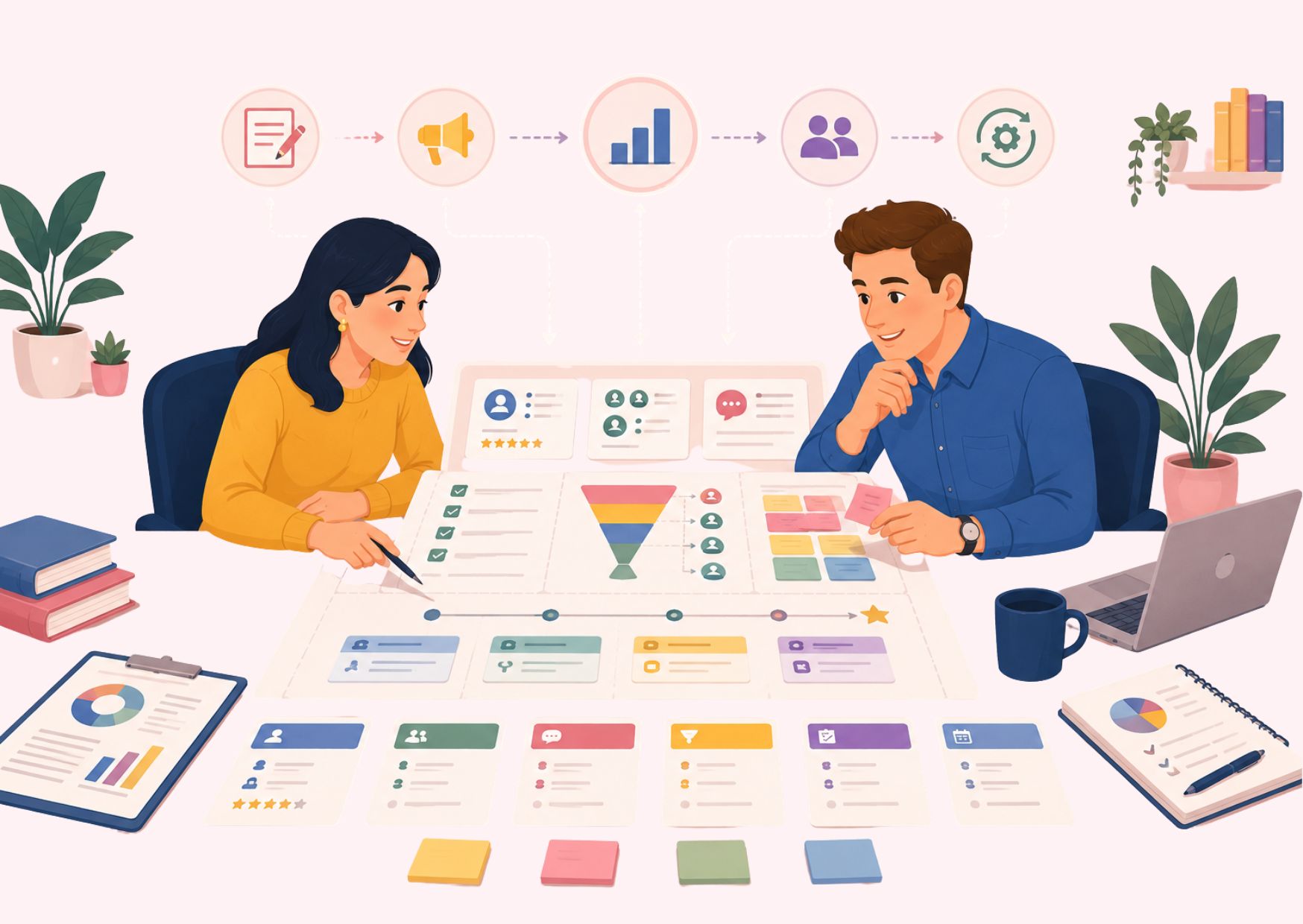
Strategy before tactics, every engagement









Sound Familiar?
The 6 common problems small businesses face from starting without strategy.
Businesses between £1–5m invest significantly in marketing before they have the strategic foundation to make that investment work.
1
"We're creating a lot of content but it doesn't seem to be attracting the right clients."
Content created without a defined Ideal Customer Profile reaches a broad, poorly qualified audience. Volume accumulates without producing the enquiries the business needs, and the team cannot diagnose why because there was no agreed target to measure against.
2
"Every person in the business describes what we do differently."
Without documented positioning, messaging is shaped individually by whoever is speaking. Prospects receive inconsistent signals about what the business does, who it serves, and why it is the right choice, and trust erodes as a result.
3
"We're active on multiple channels but we're not sure any of them are working."
Channel selection without a strategy defaults to where the team is comfortable or where competitors appear. Activity increases without clarity on whether any particular channel is producing meaningful results, because there is no defined goal to measure against.
4
Marketing priorities shift constantly and we never finish what we started."
Without agreed growth priorities, every new idea competes equally for attention. The team starts multiple initiatives, completes few of them, and never accumulates the momentum that comes from sustained focus on a small number of high-leverage activities.
5
"We don't know what differentiates us from our competitors."
Businesses without a completed competitive analysis cannot make a credible claim to distinctiveness. Marketing defaults to generic category messaging, which attracts clients making decisions on price rather than on fit.
6
"The founder is still the one closing every deal because nobody else understands the offer well enough."
When positioning and messaging are held in the founder's head rather than documented, the team cannot represent the business accurately in sales conversations. Growth is capped by the founder's personal availability rather than the quality of the business's proposition.
MarketingOS
The Proven 7-Step Process to Building a Sustainable Marketing System.

What You Get
The foundation that makes everything else work.
Strategy First Plan is the opening phase of the Marketing Operating System, a structured 30–45 day engagement that produces the strategic foundation every subsequent step runs on. Nothing in the Marketing OS is built before this phase is complete.
"If decisions don't happen in the meetings, Strategy First isn't finished."
The first step in the Marketing Operating System is not a workshop, a discovery call, or a template to fill in. It is a structured sequence of three decision-heavy meetings across 30–45 days, with the Fractional CMO leading every session and conducting the research, synthesis, and draft work between them.
Meeting 1 establishes context and clarifies goals. The research and brand audit happen between Meeting 1 and 2. Meeting 2 pressure-tests the findings and locks the core decisions, ICP, positioning, and messaging direction. The strategic plan is built between Meeting 2 and 3. Meeting 3 presents the complete plan, validates the priorities, and confirms the first 90 days of execution.
The founder's time commitment across all three meetings is three hours. Everything between those meetings is fCMO-led. The output is not a slide deck, it is six operational documents that become the working inputs to every other phase of the Marketing Operating System.
Our Impact in the World
Marketing Systems built for entrepreneurs across 7+ countries.
Since 2023, Growth Genies has partnered with founders and leadership teams across seven countries, installing marketing systems that compound over time, not campaigns that run for a quarter and disappear. Every number below represents a business that replaced reactive, habit-driven marketing with a structured system, and started seeing results they could predict, explain, and build on.
How It Works
3 meetings. 6 deliverables.
1 foundation.
Strategy First Plan runs across three 60-minute meetings over 30–45 days. Each meeting has a defined purpose, a set of decisions to lock, and clear outputs. The fCMO leads all preparation and synthesis between sessions.
Discovery & Intake Review
"What does working marketing look like in 12 months?"
The fCMO reviews the completed intake form, clarifies business goals and constraints, explores the current marketing reality, confirms ideal client hypotheses, and agrees the research and interview plan for the following weeks. The session establishes context and aligns the room on what the engagement is designed to achieve before any research begins.
Research & Insights Review
"Where are we meaningfully different, and what does that mean for how we show up?"
The fCMO presents the marketing and brand audit, competitive landscape summary, ideal client interview themes, developed persona, and a draft core message and positioning. The room challenges assumptions, discusses tradeoffs, refines the messaging direction, and locks the primary ICP, positioning direction, and core messaging themes. This session produces the green light to build the strategic plan.
Strategic Plan & Direction
"Are we aligned on where we're going and how we're getting there?"
The fCMO presents the complete strategic plan, strategic overview, Marketing Hourglass, content strategy with pillars and purpose, growth priorities, and 90-day execution calendar. The strategy is reviewed end-to-end, priorities are validated, adjustments are made live, and ownership and channel focus are confirmed. The session concludes with strategy approved, the execution calendar agreed, and Phase 2 scope confirmed.

What Changes In Your Business
What entrepreneurs experience in the first 90 days.

Marketing budget goes to things that connect to a defined outcome
Without a strategy, budget allocation follows habit, instinct, or whoever made the most recent case for a particular channel. With the Strategy Brief in place, every investment is evaluated against the agreed growth priorities and ICP before it is approved. Budget that previously produced ambiguous results starts producing campaigns that can be evaluated against something, and the evaluation loop creates the feedback that makes each quarter better than the last.

The Marketing OS build begins from a foundation rather than from assumptions
Every subsequent step of the Marketing Operating System, the Workstream Engine, Campaign Builder, AI Marketing Hub, Scorecard and Signals, Momentum Meeting, and Optimisation Loop, uses the Strategy First outputs as its working inputs. The quality of the foundation determines the quality of everything built on top of it. Businesses that skip Strategy First Plan spend their entire engagement compensating for the decisions they deferred.
The process
Three sessions.
One 90-day plan.
We facilitate three structured working sessions across 3–4 weeks. Between sessions, we synthesise inputs, prepare drafts, and resolve outstanding questions, so that each session begins with materials ready for your review rather than for joint construction from scratch.
Engine Alignment & Campaign Priorities
We review strategic priorities, complete the Engine Builder Canvas across Brand, Growth, and CX, identify engine gaps or misalignment, and select one to two priority offers for the quarter. This session also defines what is explicitly out of scope, preventing scope creep before execution begins and establishing shared expectations on campaign volume.
Campaign Design Working Session
For each selected campaign, we complete a Campaign Builder Canvas, defining goal, offer, audience, core message, channel selection, CX considerations, required content assets, CTA, and success signals. Strategy becomes campaign-ready here. Execution details are noted but not actioned, that belongs to the Workstream Engine in the phase that follows.
Campaign Calendar & Readiness Review
All campaigns are mapped into the 90-Day Planner with launch windows, promotion pacing, and identified dependencies. Each campaign then passes through the Readiness Checklist, five required sections covering engine alignment, campaign clarity, scope, capacity, and measurement readiness. Campaigns that do not clear all five gates do not proceed to execution. No exceptions.

Words of Appreciation
From the businesses we've helped.
Raman has sharpened our focus on the high-impact tasks that drive growth and eliminated operational clutter, dramatically boosting our efficiency. His strategic insights offer an independent perspective that keeps us firmly aligned with our long-term business goals. Thanks to Raman’s systems expertise, we’re operating more smoothly than ever and accelerating toward our objectives.

"Working with Raman has been a game-changer for our tax department. His strategic marketing insights helped us clearly define and reach our target audience—both internally and externally. He brought a fresh perspective to how we position and communicate complex tax content, ensuring it's both accessible and engaging. Raman played a pivotal role in designing and refining our newsletters. From content structure to visual aesthetics, his input made our communication more impactful and aligned with our brand identity. Thanks to his efforts, our newsletters now see significantly higher engagement and have become a reliable touchpoint for sharing tax updates and insights. He also supported us in mapping a content strategy that balances technical depth with readability, ensuring we maintain credibility while expanding our reach. Raman’s ability to translate technical tax jargon into meaningful messages for our stakeholders is truly commendable. We are grateful for his support and would highly recommend him to any team looking to elevate their communication and outreach strategy."

As a solopreneur, it's helpful to have people in my network who can support me and my clients when things get busy. Raman Dhalwani has been a life saver for me by putting together Marketing and Brand Audits for clients. He's very thorough and always manages to surprise and delight me with the extra effort and ideas he brings to the table. Having him as a partner has been invaluable to me.

It’s been amazing working with you! The new logo aligns perfectly with our brand, and the Intelligent Auditing website is exceptionally well-organized. The colour scheme is spot on, and the overall user experience is smooth.

A very professional, friendly & timely delivered service! Would definitely recommend getting the Growth Genies impactful support!
Need to know more?
Common Questions Entrepreneurs Ask Us
We already have a brand and some marketing running. Do we still need Strategy First?
Yes, and often more urgently than a business starting from scratch. Businesses with existing marketing activity have accumulated assumptions, habits, and channel commitments that may or may not be producing results. Strategy First audits what is currently running, identifies what is contributing to growth and what is creating drag, and produces a foundation that confirms which existing activities to build on and which to change. Proceeding directly to the Marketing OS build without this audit risks amplifying activity that should be refined rather than accelerated.
How much time does this require from the founder?
Three one-hour meetings across 30–45 days, plus time to complete the intake form before Meeting 1. The fCMO conducts all research, competitive analysis, persona development, strategic synthesis, and plan development between sessions. The founder's role in each meeting is to provide context, challenge the findings, and make decisions, not to prepare materials or produce work between sessions. Most founders describe the commitment as the most time-efficient strategic investment they have made, given the volume of work the fCMO produces between each session.
What if we don't agree with the fCMO's findings or recommendations?
Disagreement is part of the process, particularly in Meeting 2, where the research findings are deliberately presented for challenge and pressure-testing. The fCMO's role is to bring an objective external perspective grounded in market research and competitive analysis, not to present conclusions as fixed. Tradeoffs are discussed openly and the direction taken is always the one the leadership team has genuinely agreed to, not the one the fCMO prefers. Decisions that are not genuinely owned by the leadership team do not survive the execution phase, and the fCMO knows this.
What happens if we're not ready to commit to the full Marketing OS after Strategy First?
Strategy First is a complete, standalone engagement with its own deliverables. Businesses that complete the phase and then pause before moving into the full Marketing OS build leave with an approved Strategy Brief, ICP, positioning, Marketing Hourglass, content strategy, and 90-day execution calendar, all of which can be implemented by an internal team or other partners. The value of the phase does not depend on committing to the subsequent steps. Many businesses use Strategy First as a reset after a period of unclear marketing activity, and proceed at their own pace into the OS build.
How quickly can we start after signing?
Meeting 1 is scheduled as soon as possible after the agreement is signed and the intake form is completed, typically within one to two weeks. The intake form is sent immediately after signing and typically takes 30–45 minutes to complete. The faster the intake form is returned and access to key tools is granted, the sooner the fCMO can begin the pre-meeting research and the earlier Meeting 1 can be scheduled. Most engagements hold Meeting 1 within ten business days of the agreement date.
How does Strategy First connect to the rest of the Marketing Operating System?
Every subsequent step in the Marketing OS uses a Strategy First output as its working input. The Workstream Engine uses the 90-day execution calendar and growth priorities to define workstream scope. The Campaign Builder uses the ICP, positioning, and Marketing Hourglass to design campaigns. The AI Marketing Hub uses the brand voice and messaging framework to configure AI playbooks. The Scorecard and Signals phase uses the Marketing Hourglass stages to define journey metrics. The quality of the strategic foundation determines how effective every subsequent phase can be, which is why no other step begins before Strategy First is complete and approved.
Start Your Transformation
Stop Marketing Without a Strategy.
Strategy First is Step 1 of the Growth Genies Marketing Operating System. Book a free 30-minute Productive Chat and we will walk through what the phase looks like for your business, what it produces, and what comes after.
Work With Us
Resources
Make better decisions every week
If you're a solopreneur, startup or SME founder who's looking for some practical advice to help you make better marketing and business decisions every week, then you're in the right place.


